Corporate modernisation often assumes a linear principle: any procedure that software can perform should be automated immediately. Under this premise, organisational efficiency is frequently assessed by the volume of processes transferred to technology platforms and the corresponding reduction in human intervention.
In sectors where quality depends on complex physical tolerances—technical clothing, leather or specialised compounds—automation can improve precision and productivity. Risk arises when material knowledge is replaced without retaining the internal capacity to assess the process. Using cutting software does not necessarily transfer all expertise to the supplier: what matters is how work is organised and which capabilities are retained.
Sharing software with competitors does not inevitably homogenise processes. Data, configurations, materials and craft knowledge can create differences. Dependence becomes critical when the organisation can no longer audit quality, correct failures or change suppliers without losing technical expertise.
Limits as an explicit governance decision
An alternative to adoption by inertia is to define which material practices should be retained and which tasks can be automated with controls. The advantage lies in retaining the capabilities needed to assess and correct results, rather than in rejecting technology generally.
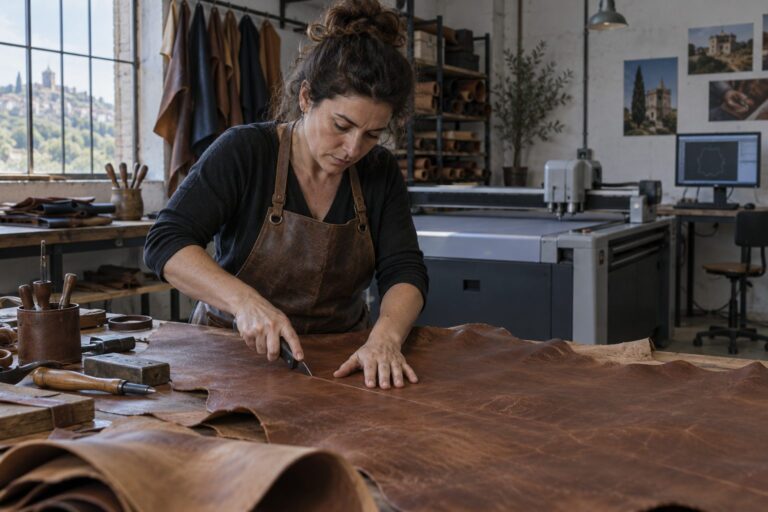
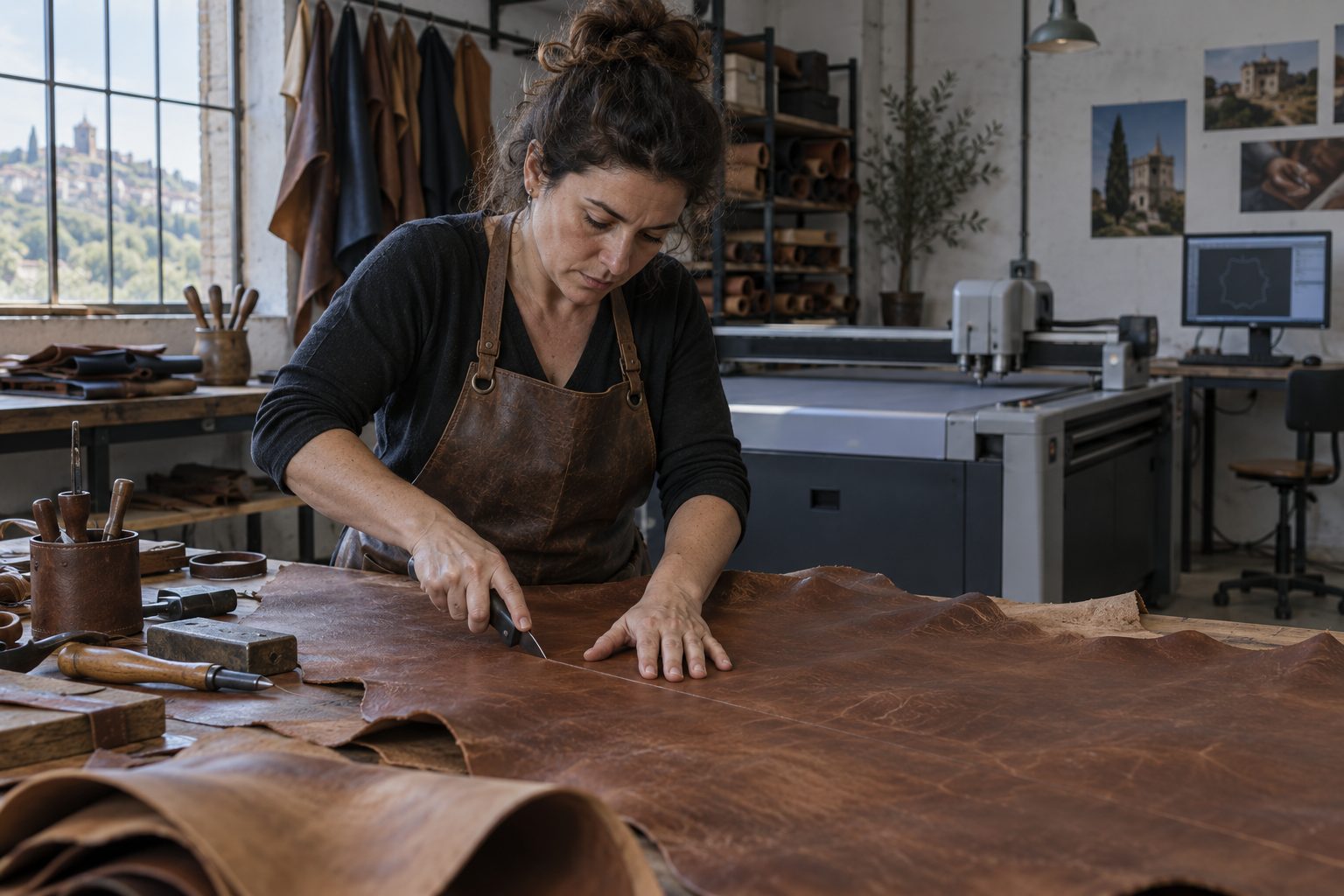
Leatherworking makes this decision tangible. In a workshop, assessing feel, elasticity and the behaviour of each batch may justify reserving certain checks for human expertise alongside technical assistance. Ubrique is used here as a reference for the sector, rather than as evidence of a general prohibition on digital cutting: no such prohibition has been verified, and MOVEX documents projects for productive improvement and innovation.
A reserve of material judgement can be justified on three grounds that must be tested for each process:
1. Assessing relevant material properties
Touch and experience may reveal variations in density, fibre direction or elasticity that a particular system does not measure adequately. The reserve should be based on quality tests and the actual limitations of the sensors used. Neither all manual cutting guarantees durability nor all automation relies on an average indifferent to the material.
2. Retaining the capacity to correct
Automating without practice, training or independent diagnosis can weaken correction capabilities. Teams need to retain contact with materials and the ability to investigate why a product fails, even when sensors and software improve detection. Loss of competence is an organisational design risk, rather than an automatic consequence of introducing machinery.
3. Control of the process despite technical dependence
Retaining documented and practical knowledge within the workshop, alongside accessible data and continuity options, reduces dependence on a proprietary environment. Autonomy does not necessarily require excluding software from core production: it requires the ability to understand, audit and replace it when necessary.
Govern technology or accept transfer by omission
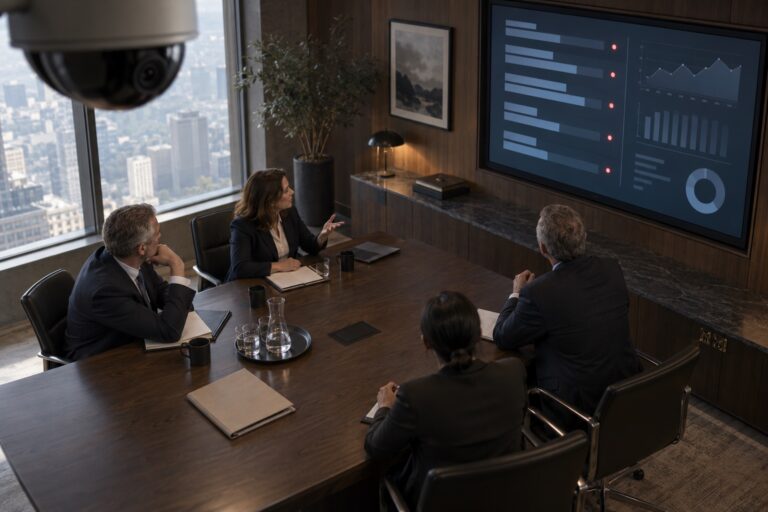
The fundamental problem facing boards and management committees is not the technical feasibility of artificial intelligence, but the absence of a deliberate policy defining its boundaries.
If an institution does not document the capabilities it needs to retain, delegation can accumulate. One department adopts software to accelerate a deliverable and another introduces drafting assistance; without reviewing training and continuity, the organisation may discover that it has lost the capacity to respond to failure or disconnection.
Deciding the limits of delegation is a governance responsibility. Integrating technology can strengthen productivity; transferring critical functions without examining quality, learning, dependence and continuity is a weakness of organisational design.
An institution’s long-term resilience will be measured not only by the sophistication of its software, but also by the clarity with which it establishes its reserves: what, for reasons of rigour, safety and structural value, it chooses not to hand over to a machine.